
Wings, Stings & Buzzing Things
Ever wondered how insects eat, why they’re important, or what makes a beetle different from a butterfly?
Discover the tiny creatures that run the world in this insect investigation where students will:
-
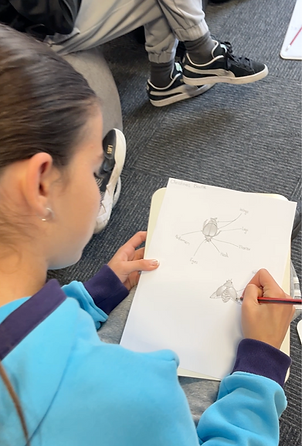
Learn insect anatomy
-
Classify and compare insects
-
Explore the vital role insects play in our ecosystems
-
Use real specimens for an authentic experience
*additional travel costs may apply for outside 25km radius
EYLF Connections
Learning Outcomes
-
Children have a strong sense of identity
-
Children are connected with and contribute to their world
-
Children have a strong sense of wellbeing
-
Children are confident and involved learners
-
Children are effective communicators
Principles
-
Secure, respectful and reciprocal relationships
-
Partnerships
-
Respect for diversity
-
Equity, inclusion and high expectations
-
Sustainability
-
Critical reflection
-
Collaborative teamwork
Practices
-
Holistic, integrated and interconnected approaches
-
Responsiveness to children
-
Play-based learning and intentionality
-
Learning environments
2024 NSW K-6 Science Syllabus Links
Stage 1
Students will:
-
Describe the changes in an animal as it goes through its life cycle using data and scientific models
ST1-SCI-01: Measure and describes changes in living things, materials, movement, Earth and the sky
ST1-PQU-01: Poses questions based on observations and information to investigate cause and effect
ST1-DAT-01: Collects, represents and uses data to identify patterns and relationships
Stage 2
Students will:
-
Describe the relationship between habitat, ecosystem and environment
-
Observe and describe living and non-living things in a habitat
-
Describe ways in which plants and animals depend on each other for survival
ST2-SCI-01: Uses information to investigate the effects of energy on living, physical and geological systems
ST2-PQU-01: Poses questions to create fair tests that investigate the effects of energy on living things and physical systems
ST2-DAT-01: Uses and interprets data to describe patterns and relationships
Stage 3
Students will:
-
Observe behavioural and structural adaptations of plants and suggest how these may help them survive in their environment
-
Identify and describe how the loss or introduction of plants or animals affects an Australian ecosystem
ST3-PQU-01: Poses questions to identify variables and conducts fair tests to gather data
ST3-DAT-01: Interprets data to support explanations and arguments
ST3-CWT-01 Creates written texts to communicate understanding of scientific and technological concepts and processes
Australian Curriculum (Yr 1 & 2) AC9S1U01: identify the basic needs of plants and animals, including air, water, food or shelter, and describe how the places they live meet those needs AC9S1I01/AC9S2I01: pose questions to explore observed simple patterns and relationships and make predictions based on experiences AC9S1I02/ AC9S2I02: suggest and follow safe procedures to investigate questions and test predictions AC9S1I03/ AC9S2I03: make and record observations, including informal measurements, using digital tools as appropriate AC9S1I05/ AC9S2I05: compare observations with predictions and others’ observations, consider if investigations are fair and identify further questions with guidance
Australian Curriculum (Yr 3 & 4) AC9S3U01: compare characteristics of living and non-living things and examine the differences between the life cycles of plants and animals AC9S4U01: explain the roles and interactions of consumers, producers and decomposers within a habitat and how food chains represent feeding relationships AC9S3I01/AC9S4I0: pose questions to explore observed patterns and relationships and make predictions based on observations AC9S3I02 AC9S4I02: use provided scaffolds to plan and conduct investigations to answer questions or test predictions, including identifying the elements of fair tests, and considering the safe use of materials and equipment AC9S3I03/ AC9S4I03: follow procedures to make and record observations, including making formal measurements using familiar scaled instruments and using digital tools as appropriate AC9S3I05/ AC9S4I05: compare findings with those of others, consider if investigations were fair, identify questions for further investigation and draw conclusions
Australian Curriculum (Yr 5 & 6) AC9S5U01: examine how particular structural features and behaviours of living things enable their survival in specific habitats AC9S6U01: investigate the physical conditions of a habitat and analyse how the growth and survival of living things is affected by changing physical conditions AC9S5I01/AC9S6I01: pose investigable questions to identify patterns and test relationships and make reasoned predictions AC9S5I02/ AC9S6I02: plan and conduct repeatable investigations to answer questions, including, as appropriate, deciding the variables to be changed, measured and controlled in fair tests; describing potential risks; planning for the safe use of equipment and materials; and identifying required permissions to conduct investigations on Country/Place AC9S5I03/ AC9S6I03: use equipment to observe, measure and record data with reasonable precision, using digital tools as appropriate AC9S5I04 / AC9S6I04: construct and use appropriate representations, including tables, graphs and visual or physical models, to organise and process data and information and describe patterns, trends and relationships AC9S5I05 / AC9S6I05: compare methods and findings with those of others, recognise possible sources of error, pose questions for further investigation and select evidence to draw reasoned conclusions
2023 NSW 7-10 Science Syllabus Links
Stage 4
-
SC4-CLS-0: Describes the unique features of cells in living things and how structural features can be used to classify organisms
-
SC4-LIV-01: Describes the role, structure and function of a range of living systems and their components
-
SC4-DA1-01: Explains how data is used by scientists to model and predict scientific phenomena
-
SC4-WS-06 WS Analysing data and information: Uses data to identify trends, patterns and relationships, and draw conclusions
-
SC4-WS-04 WS Conducting investigations: Follows a planned procedure to undertake safe and valid investigations
-
SC4-WS-03 WS Planning investigations: Plans safe and valid investigations
-
SC4-WS-02 WS Questioning and predicting: Identifies questions and makes predictions to guide scientific investigations
-
SC4-WS-01 WS Observing: Uses scientific tools and instruments for observations